Resource library

Guidance, toolkits and project examples

Selected international resources for hospital commissioning, readiness, activation and transition, each annotated with what it contains and why a project team might use it.

Resources reviewed September 2026

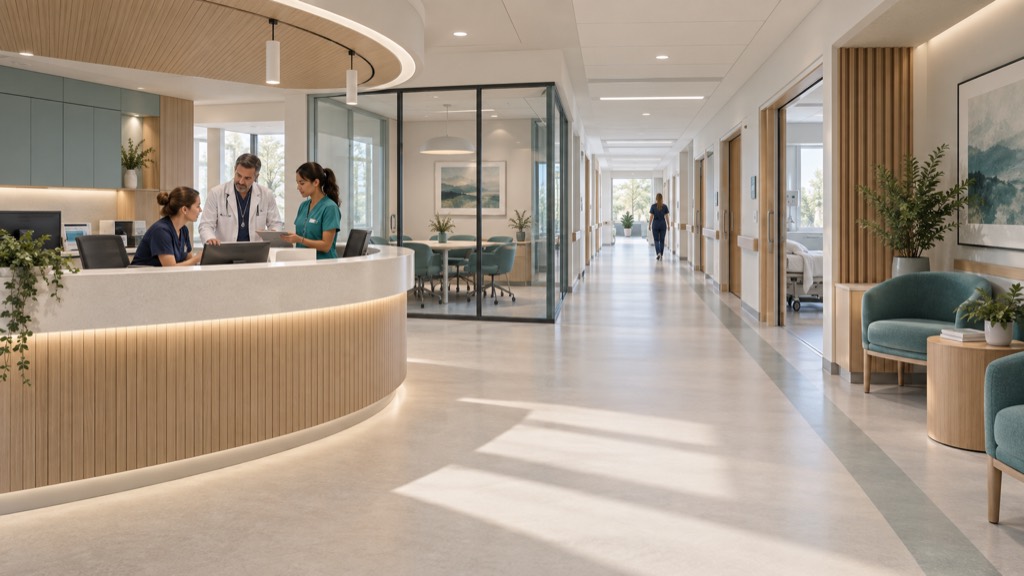
A new ward reception with staff reviewing information at the desk and a long, sunlit corridor leading to patient rooms.
Illustrative image

Linked organisations are independent of this website; inclusion does not imply endorsement. Check whether a resource applies to your project’s location and services — England-specific NHS guidance is not UK-wide guidance.

Showing all 8 resources

What the resource types mean
Guidance
Published guidance or reference material.
Toolkit
A structured tool or method a team can apply.
Project example
An account of how a specific project prepared for opening.
Historical project example
A past project or review, useful for learning rather than as a current assessment.
Guidance Scope Australia and New Zealand

Australasian Health Facility Guidelines — Part F: Project Implementation

Source Australasian Health Infrastructure Alliance (AHIA)

What it contains
Guidance organised in two sections — operational commissioning, and furniture, fittings and equipment (FFE) — each available as a separate download. The page lists Revision 5.0, dated 1 March 2016.
Why a project team would use it
A strong starting point for teams developing their commissioning approach: it helps define commissioning scope and organise project preparation.

Note: Written for Australian and New Zealand projects. Assess terminology and requirements against UK standards before applying.

Link checked 25 September 2026

Project example Scope England

Midland Metropolitan University Hospital — programme annexes

Source Sandwell and West Birmingham Hospitals NHS Trust

What it contains
An unusually detailed public pack of 20 annexes covering readiness criteria, pathway and interdependency assurance, logistics, workforce, IT, equipment, an activation plan (Annex 11), a move plan (Annex 12) and a readiness-for-service review.
Why a project team would use it
Shows how one real NHS programme connected workstreams, dependencies, governance and opening preparations.

Note: A project-specific example, not a template to adopt unchanged.

Link checked 25 September 2026

Guidance Scope England

Health Building Notes and Health Technical Memoranda

Source NHS England

What it contains
Health Building Notes give best-practice guidance on the planning and design of new healthcare buildings and the adaptation of existing ones. Health Technical Memoranda cover the design, installation and operation of specialised building and engineering technology, including ventilation, water, medical gases, electrical services and fire safety.
Why a project team would use it
Connects operational requirements with the relevant design and engineering guidance.

Note: Published for England. Scotland, Wales and Northern Ireland maintain their own technical guidance; confirm which applies to your project.

Link checked 25 September 2026

Toolkit Scope United States

Health Care Facility Design Safety Risk Assessment Toolkit

Source Agency for Healthcare Research and Quality (AHRQ)

What it contains
An introduction to a toolkit, developed by the Center for Health Design with AHRQ funding, that helps teams consider safety risks in the built environment.
Why a project team would use it
Structures conversations about how layout and design affect patient and staff safety before occupation.

Link checked 25 September 2026

Guidance Scope United States

Simulation training — PSNet primer

Source AHRQ Patient Safety Network (PSNet)

What it contains
An overview of how simulation can support workflow testing and help identify hidden safety problems.
Why a project team would use it
Useful background when planning walkthroughs, simulations and rehearsals in a new facility.

Note: When this library was reviewed, the page refused connections from the UK, so its content could not be re-checked. It may not open for UK visitors.

Link not verified at last review

Project example Scope Canada (British Columbia)

How Burnaby Hospital is using mock moves to prepare for its first patient day

Source Fraser Health · published 9 February 2026

What it contains
A short account, published February 2026, of mock moves used to explore patient scenarios, coordinate staff responsibilities, test routes and transfer times, and plan communication with patients’ families and care partners.
Why a project team would use it
Helps explain the value of mock moves to clinical teams and programme stakeholders.

Link checked 25 September 2026

Historical project example Scope Australia (Western Australia)

Review of operational, clinical and patient care at Fiona Stanley Hospital

Source Department of Health, Western Australia (WA Health)

What it contains
An independent review, commissioned after the hospital’s phased opening from October 2014, that assessed its clinical and patient-care processes, systems and practices. The page links to the final report.
Why a project team would use it
Highlights the importance of operational support and review after the opening milestone.

Note: A historical case study, not an assessment of the hospital’s current performance.

Link checked 25 September 2026

Toolkit Scope Global

Water and Sanitation for Health Facility Improvement Tool (WASH FIT), second edition

Source World Health Organization and UNICEF

What it contains
A practical improvement tool covering water, sanitation, hand hygiene, environmental cleaning, healthcare waste and selected aspects of energy, building and facility management, with fact sheets, checklists and assessments.
Why a project team would use it
Supports a close look at essential environmental services within a wider readiness programme.

Note: Not a complete hospital activation framework.

Link checked 25 September 2026